
The Space Between

Finding ways to put the patient voice at the center of an interoperable world
A couple of weeks ago I came across two sets of anecdotes that I found myself dwelling over. One exemplified how patients often do not feel heard when it comes to their health concerns and the other that those requiring more complex care often feel they have to be the ones coordinating their own care. I think a lot of us in the health tech interoperability space often are sympathetic to these issues, but don’t often view them as squarely in our domain to solve. It’s just the biases of individual clinicians and lack of proper incentives to be a champion for the patient, right? But the nagging thought I had was: well…what could we do?
The first was a story circulated on my work Slack from the former employee of a customer. She told a story about helping a patient by being able to spend hours digging through years of their records in order to correct a previous misconception about the patient which had been hardened in the documentation by various clinicians over time. I didn’t love that they had to spend hours digging, but what I lingered over was how they were able to construct the correct narrative through structured and unstructured data: she just needed to do forensics. She also noted that any AI summary generated of the patient’s medical history certainly picked up on the tone (perhaps dismissive) of the previous documentation and delivered accurate summaries of what the clinicians had documented. What she found though was an off-hand comment buried in the mountains of text stating why the patient never took an important medication: It was much too expensive. The ensuing documentation simply listed the patient as non-compliant and perhaps uncooperative.
The second was a post I happened to come across on Bluesky:
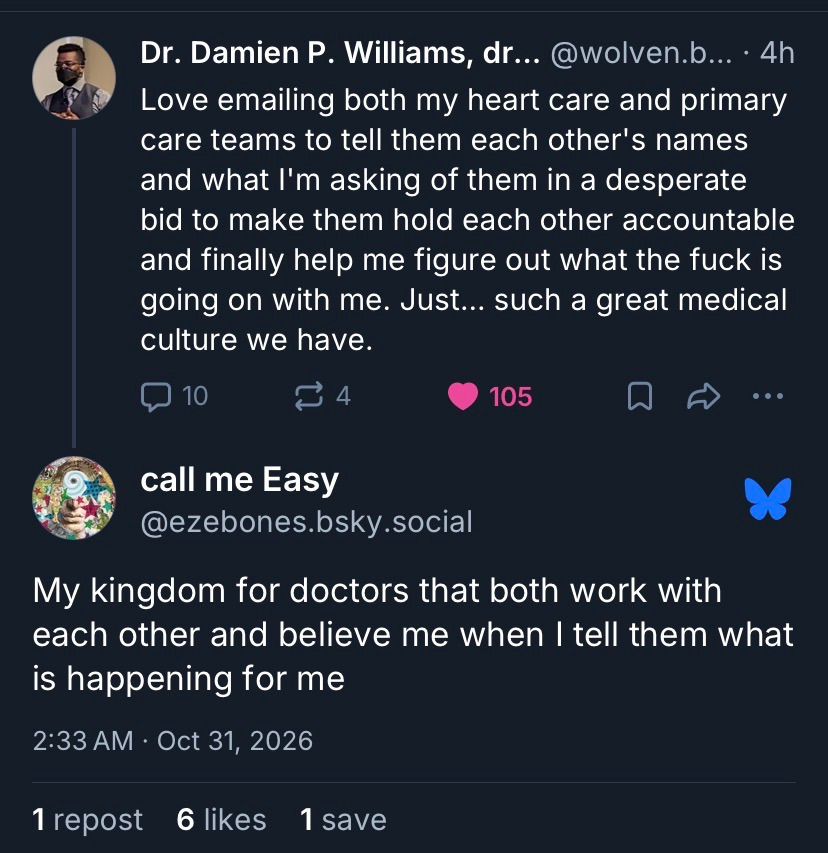
I almost scrolled right by the original post and the following comment because nothing about these situations struck me as atypical. “Yeah, that’s pretty much how a lot of people experience healthcare.“ was what immediately came to mind. After doomscrolling on for a minute, I scrolled back up and lingered on it. I thought of the Gallup survey released this fall where half of women said that in the past five years a provider had dismissed their symptoms, misdiagnosed them, or left them without answers, compared to 39% of men. I thought of the Colorado survey where adults with a disability were more than two and a half times as likely as adults without one to say a provider had ignored or dismissed their concerns. I thought of the well known concerns of racial discrimination. I thought of how quickly and easily people turn to and get scammed by the mostly unregulated wellness industry that rakes in trillions of dollars and promises cures for all the things “regular” healthcare won’t help you with. I thought of the increasing number of patients that are willing to give over their medical records and deepest health secrets and concerns to ChatGPT, or Gemini, or Claude with little concern for what those companies might do with that information let alone the risk of them providing bad and potentially harmful, if not life-ending advice.
Patients are often desperate for someone to listen to them by the time they are a patient; they are desperate for answers, and often desperate for someone to simply get two of the people that are supposed to be providing them care to just talk to each other and look at the same thing at the same time. The overwhelming feeling I always get every time I hear these stories is that these screams into the void are just exceptionally reasonable requests from reasonable people trapped in a broken system that makes them feel insane.
It’s not that channels for inserting the patient’s own voice or payment for collaboration don’t exist. They do; they just are both rarely used and inadequate for the needs that aren’t being met. Looking at the systems and frameworks that do exist though, we can see just how much of an uphill battle this is.
The walls aren’t actually listening
Part of this obviously lies with how individual clinicians interact with and have empathy for their patients. In a 2016 study, half of the white medical students and residents held false beliefs about biological differences between Black and white patients; those same individuals rated Black patients’ pain lower than others. An analysis of nearly 49,000 hospital admission notes found that stigmatizing language like “noncompliant” was 26.8% more likely to show up in notes about Black patients than white patients. While the bias is real and should be addressed, we can also seek to mitigate perpetuating that bias.
A patient’s dismissed concern either is referred to vaguely and skeptically if it is even documented at all. A dismissive note gets exchanged, copied forward, summarized, and scored by every system downstream of it. One study at UCSF found that only 18% of the text in inpatient progress notes was typed fresh; 46% was copied from somewhere else. “Non-compliant” doesn’t need to be re-observed to be re-documented. It just needs to survive a copy and paste.
Hopefully it comes as no surprise to those reading this that electronic medical records were not designed to be inclusive communication machines. They were, and are still designed to present the evidence necessary in order to get paid for an encounter. Hospitals computerized claims first, and once Medicare started paying per diagnosis group, accurate coding became a financial necessity. What gets a structured field is what gets paid. Diagnoses and procedures got codes and everything got neat little boxes. As someone who spent years shadowing nurses and physicians in exam rooms “helping them with the computer” I can attest that the structure of the modern exam likes to focus on the solvable problems and instruction to “call if anything changes” is given to those concerns that are more ambiguous. This isn’t for lack of empathy or skill of the clinicians, they are rightly trained to tackle the most pressing issues in the limited time available and a number of things simply just go away on their own. But untreated concerns can also fester. Even when data exchange between health systems became a thing, any patient messages that might be sent through the portal, the only home for their direct digital voice, is left by the wayside when it comes to sending their medical records through the networks.
You can also see it in the code sets themselves. There is no ICD-10 code for “the patient doesn’t think this diagnosis is right” or “the patient is still worried and we haven’t figured it out yet.” The closest thing is Z71.1, “person with feared health complaint in whom no diagnosis is made,” whose inclusion terms literally include “worried well.” [Stares in informaticist…]. Codes for social circumstances, which are a part of overall health concerns, do exist, and let’s all thank the Gravity Project for their work on these. The patient’s story I came across who was “noncompliant” could have benefited from a coded indication of financial hardship relating to why they weren’t taking a medication. In 2019 those social codes showed up on claims for only 1.59% of Medicare beneficiaries, and CMS’s own explanation was that there is no financial incentive to use them and there’s not much indication that adoption is strongly taking off.
What good are tools that no one uses?
To be fair to our humble corner of the industry, we have done a lot. According to the ONC, the share of hospitals that can send, receive, find, and integrate outside data went from 46% to 70% between 2018 and 2023. TEFCA is live. FHIR APIs are mandated. Moving data and having someone read it are two different things though. In the same ONC data, 71% of hospitals had outside information available at the point of care, and only 42% said their clinicians often used it. In an older national survey, 69% of primary care physicians said they usually send the patient’s history along with a referral, and only 35% of specialists said they usually get it. Somewhere between “sent” and “read,” the patient’s story falls on the floor, and the patient often has to be the one jumping up and down while shouting to have their disparate “Care Team” look at what is important and direct them to send it to someone else.
Medicare does pay for coordination, just in forms that are hard to use. Chronic care management reached about 4% of eligible beneficiaries in 2019 and has hovered there since, in part because patients get charged 20% coinsurance for work they never see. The eConsult codes that let two clinicians talk about a patient require at least 16 minutes on the requesting side, patient consent to cost sharing, and get voided if a visit follows within two weeks. The five-minute “are you seeing what I’m seeing?” call that the Bluesky poster is begging for doesn’t qualify, and if it did, the patient would get the bill. Maybe the patient should get paid for all this care coordination they are doing? Meanwhile, the two CMS primary care models most built around coordination, Making Care Primary and Primary Care First, were ended early in 2025, and last month’s HTI-5 final rule removed the care plan certification criterion for EHRs.
I’ll admit to not having all of the C-CDA standards memorized (and if you do, you have achieved goddess-like status, congrats), so I was a little surprised that the patient voice is even included in there because I certainly haven’t seen anything come across much in my work. However, C-CDA’s Health Concerns section defines a health concern as something “of interest, importance or worry to someone, who may be the patient, patient’s family or patient’s health care provider,” and it explicitly includes “patient-reported concerns.” USCDI has a Health Concerns element. US Core’s Condition profile has a “health-concern” category. These “standards” are a bit lacking in terms of granularity though.
USCDI v3 defines Health Concerns only as a “health-related issue or worry,” with no vocabulary standard attached, also known as “free text for everybody!”. US Core defines its category as “additional health concerns from other stakeholders” without ever naming the patient [Gestures wildly to the biggest stakeholder of all, the patient]. And USCDI’s provenance elements are an author organization and a timestamp. That tells you which organization sent something. It doesn’t tell you whether the patient said it or a clinician inferred it, which is the whole difference between “patient reports she can’t afford the medication” and “patient non-compliant.” At best we are getting the interpretation of the clinician, who may or may not hold certain biases toward the patient, of what the patient’s “health concerns” are.
Individual Access doesn’t mean you get a seat at the table
This brings me to TEFCA’s valiant push for individual access. Giving patients their records is good and long overdue, but it does not give patients the power of their voice. TEFCA’s Individual Access Services rules define that access as the ability to “access, inspect, obtain, or transmit a copy” of your information. CMS’s Interoperability Framework talks about killing the clipboard and conversational AI, but its criteria treat patients as people who request and receive data. Patients can (finally) read the story. They can’t add to it or tell it in their own words.
Under HIPAA, a patient can request an amendment to their record, and if the provider denies it, the patient can file a statement of disagreement that has to be attached to the record and sent along with future disclosures. HL7 even has an implementation guide for it, complete with a “disagreement-logged” status. So we have a standard for patients to fight with their record after it’s written, and nothing that lets them get their account in first. Let me know if you know of any patients that are aware they can even do that part, let alone have logged a disagreement.
What if individual access went both ways? Not just a list of health concerns, but the things that actually get dismissed: the patient’s description of their symptoms, in their own words, before the visit. Their timeline of what’s been tried and ruled out across clinicians. What they asked for, whether that was a test, a referral, or a second opinion. The barriers in their way, like cost or transportation. And their disagreement with an assessment, recorded at the time instead of through a formal amendment months later.
Provenance is what makes this workable. If the record plainly says “the patient wrote this,” nobody mistakes it for a clinical finding, and a clinician’s “non-compliant” sits right next to the patient’s “I couldn’t afford it.” Most of the pieces exist. US Core’s Provenance profile already allows the author to be the patient or a related person, and C-CDA already has a home for patient-reported concerns.
The other half is making dismissal visible. Each thing a patient raises should carry a status that the patient can see and every later clinician inherits: acknowledged, being worked up, addressed, deferred, or declined with a reason. A concern raised at three visits and never answered would show up as an open item instead of disappearing into free text. And we could measure it. The share of patient-raised items that get a response, and how long that takes, broken out by sex, race, and disability, would tell us far more about who is being dismissed than a survey asking whether you felt understood after the fact.
Imagine the first story with that in place. The patient, or the person helping her, enters that the prescription was never filled because it cost $4,000. Every emergency physician who pulls her record sees it, and it stays open until someone answers it. I’d like to think the “non-compliant” notes never pile up.
I don’t want to pretend this is easy. Clinicians are already drowning in their inboxes, and visibly declined requests will make legal teams nervous. The patients least heard are often the least able to use an app, so caregivers, community health workers, and peer specialists need to be able to write on their behalf. Maybe this is also an opportunity for patient-facing AI to help them communicate their story as long as that tool is accessible to those that actually need it. Of course, none of it matters if no one is paid to read it, which loops right back to the coordination problem.
I do also want to make a note about “Ambient AI” because I think a lot of people will point to this as a solution. It’s worth noting that while AI does a great job at summarizing the contents of something, it also does a great job of summarizing the tone of something as was noted in the first anecdote I came across last week. A review of the research published in September found that scribe-drafted notes tend to strip out “the patient’s narrative, values, illness experience and concerns,” and Medical Economics noted the tools were “built around the paperwork American practices already do.” This isn’t explicitly a problem with “the technology” of LLMs, but AI, like the rest of technology, perpetuates the shortcomings of the processes and systems it is seeking to make more efficient. We certainly don’t need technology to make biases bigger and more prevalent, but it will unless the technology-makers intentionally tackle that problem.

The part we can play
A few things feel within reach for those of us who build and regulate this stuff:
- ONC could add an individual author to USCDI provenance and bind a vocabulary to Health Concerns, so a patient’s statement and a clinician’s conclusion stay distinguishable when they move.
- ONC and TEFCA’s coordinating entity could make individual access two-way, letting patients and their authorized representatives submit their own account, routed to their care team with patient provenance and a response status.
- CMS could add patient contributions to the Interoperability Framework, waive patient cost sharing for clinician-to-clinician coordination, and pilot a measure of how often patient-raised items get a response.
- HL7 and implementers could publish guidance for patient-raised items with a tracked response, borrowing from the Gravity Project’s lifecycle and the corrections guide.
- EHR, AI, and data aggregation vendors could show an “in the patient’s words” section with author and status, flag copied-forward text and stigmatizing language, test scribes for omitted concerns, and surface the buried note and the unfilled prescription instead of 400 duplicate documents. I would love to pilot this at Zus, but no one is capturing, let alone sending this data yet.
I suspect a lot of us are in healthcare to do what’s right for patients and there’s certainly always a lot of talk about putting patients first. So why not continue to not just linger over these stories of patients not feeling heard or having to be their own healthcare coordinator and advocate, but start trying something, anything, in order to actually put the patient first and at the center instead of stuck in the spaces between typical healthcare operations? It is common for those in healthcare to often throw our hands up in the air and point to “the broken system” as the reason something can’t be done our at least why it’s not our problem to solve, but it is important for us to constantly try and keep the stories of those patients the healthcare system has failed at the center of what we do.

